Travel Agency CRM vs Excel and WhatsApp
CRM for travel agency in India vs Excel and WhatsApp: where spreadsheets break, what a travel CRM should cover, and when a small desk does not need one yet.
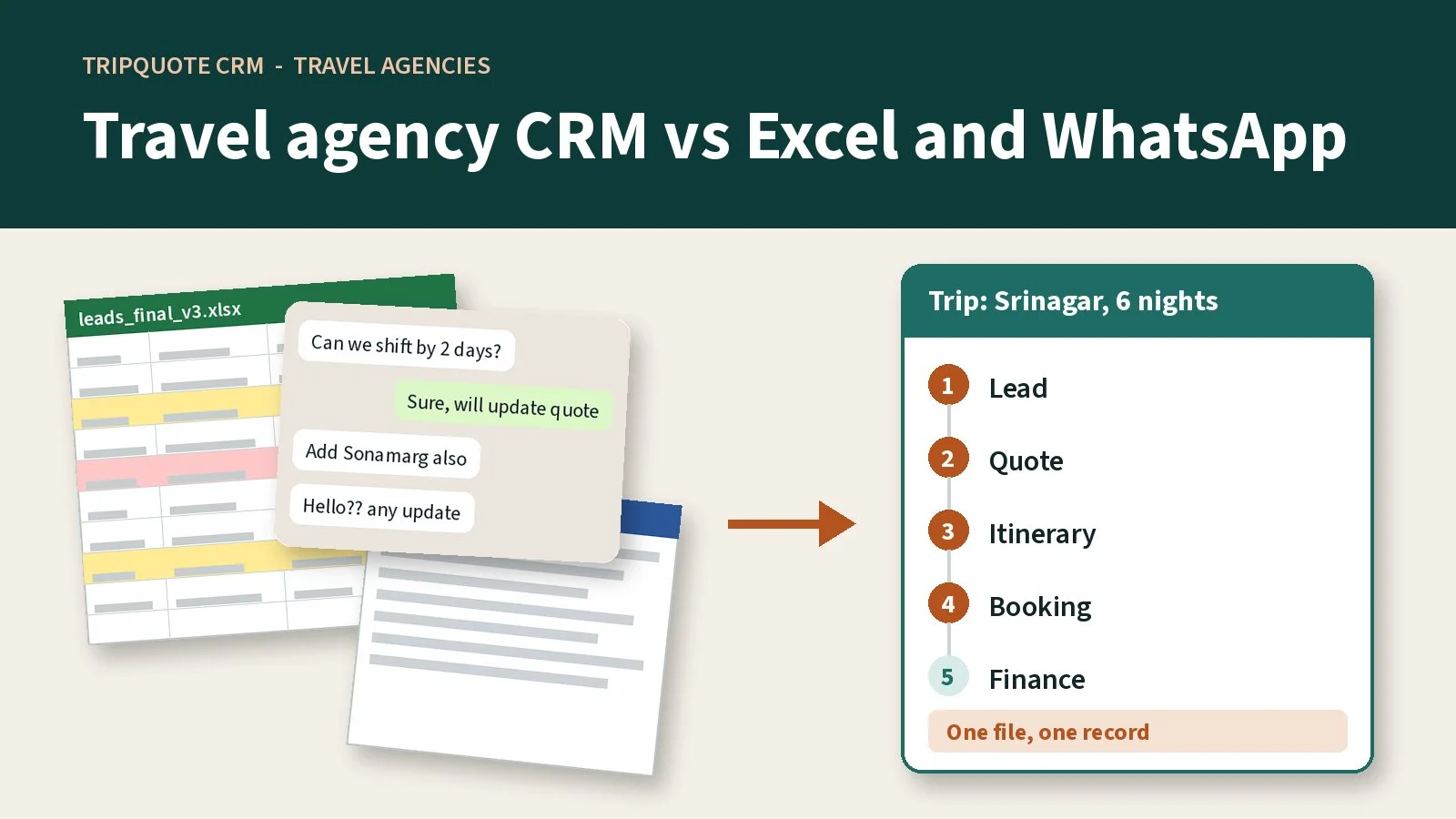
Most small travel desks in India run on three tools: WhatsApp for talking to the traveller, an Excel sheet for tracking who asked for what, and a Word or PDF file for the quote. That setup is free, everyone already knows it, and for a while it works. This post looks at where it stops working, what a CRM for a travel agency should actually cover, and when you honestly do not need one yet.
We build TripQuote CRM in Srinagar, so we are not neutral. We have tried to write this so it is still useful if you decide to stay on a spreadsheet.
How a WhatsApp and Excel desk usually works
A family messages on WhatsApp asking about six nights in Kashmir in May. Someone on the desk adds a row to the sheet: name, phone, dates, number of people, maybe a note like "wants houseboat". Then they open last month's quote in Word, change the names and dates, swap a hotel, and send a PDF back on the same chat.
The family asks to move the trip by two days and add Sonamarg. Now the change has to be made in the chat, in the sheet and in the quote file. If two people on the desk are handling leads, it also has to be clear which of them is doing it.
None of this is wrong. It is how most agencies start, including good ones. The question is how many trips the desk can carry this way before things slip.
Where the spreadsheet starts to break
There is no fixed number of leads where Excel fails. It depends on the people and the season. But the same warning signs come up again and again:
- The same trip lives in three places. The chat says one date, the sheet says another, and the quote PDF says a third. Nobody is sure which one the traveller agreed to.
- Follow-ups get missed. A lead that went quiet three days ago is only chased if someone remembers it. In a busy week, many are not.
- Quote versions pile up. "Quote_final", "Quote_final2", "Quote_new_rates". Finding the version that was actually sent takes longer than writing a new one.
- More than one person edits the sheet. Rows get overwritten, filters get left on, and someone works from a copy saved to their own laptop.
- Payments are tracked somewhere else. The advance is in the bank statement or a separate sheet, so answering "how much is still due on this trip?" means checking two or three files.
- The owner cannot see the pipeline. How many enquiries came in this week, how many got a quote and how many turned into bookings is a manual count, if it gets done at all.
In Kashmir these problems tend to show up together in peak season, when enquiries for summer, Eid holidays and the winter snow months arrive in bursts and a small team is answering all of them at once.
CRM vs Excel and WhatsApp, side by side
| Task | WhatsApp, Excel and Word | Travel CRM |
|---|---|---|
| Recording a new enquiry | Typed into a sheet by hand, if someone remembers | Saved as a lead with the traveller's details |
| Building a quote | Copy an old Word file and edit it | Built against that lead, in the same record |
| Day-wise itinerary | Another document, often a separate file | Built in the same trip file as the quote |
| Date change | Fix the chat, the sheet and the quote separately | Change it once in the trip file |
| Confirming a booking | Mark the row a different colour | The same trip moves on to a booking |
| Payments due | Check the bank statement or a second sheet | Payments tracked against the trip |
| Cost to start | Nothing extra | A software cost, plus time to set it up |
| Learning curve | None, everyone already uses it | Staff need to learn a new screen |
The last two rows matter. A spreadsheet is free and familiar, and a CRM is neither. If the problems above are not costing you trips or time, that trade may not be worth it yet.
What a travel agency CRM should cover
A general sales CRM is built around deals and contacts. A travel desk needs something closer to the life of a trip. At minimum, look for these five things in one place:
- Leads. Every enquiry recorded, with who asked and what they asked for.
- Quotes. The quotation built against the lead, not in a separate file that drifts away from it. If you want a starting layout, our travel quotation format for Kashmir trips walks through each section.
- Itineraries. The day-by-day plan in the same record as the quote, so a change to one shows up in the other.
- Bookings. When the traveller says yes, the same trip becomes a booking. No retyping.
- Finance. Payments recorded against the trip, so the desk can see what is paid and what is still due.
If a CRM you are looking at does not join these up, you may end up with a nicer-looking version of the same three-file problem.
Questions worth asking before you buy
- Can more than one person on the desk work in it at the same time?
- Does the starting price cover everything you need, or are domains, payment gateway fees and extra workflows charged separately?
- Can you see the product running before you pay?
- Who supports it, and are they reachable in your working hours?
- Does it try to do things you do not need, like hotel room management, that will only slow your staff down?
What a CRM will not fix
Software does not answer enquiries for you. If leads are slow to get a reply because the desk is understaffed, a CRM will show you that more clearly, but it will not solve it. The same goes for weak hotel or cab partnerships, or prices that are not competitive.
It also will not replace WhatsApp. Travellers in India will keep messaging you there. The point of a CRM is that the chat stops being the only record of the trip.
And it is not hotel software. TripQuote CRM, for example, does not run a hotel room rack. Hotels use a property system for that. Ours is HotelBooks, which is a separate product.
You may not need a CRM yet if...
- You are a one-person desk handling a few trips a month and you remember every traveller by name.
- Your quotes rarely change after they are sent.
- You do not chase leads, because nearly all of your business is repeat clients and referrals.
- Payments are simple, usually a single advance and a balance, and you never lose track of them.
- You are still deciding what kind of agency you want to be. Our guide on how to start a travel agency in Kashmir covers that first.
If most of that sounds like you, a tidy sheet and one standard quote format will do the job. Clean up the sheet: one row per trip, a status column, a "next follow-up" date and a single shared copy. Come back to this question when the desk grows or the season gets busier.
Moving from Excel to a CRM without losing a season
If you do decide to switch, timing matters more than the software. A few things make it easier:
- Switch in the quiet months. Do not move the desk to a new system in the middle of peak season. Pick a slow stretch so staff have time to learn it.
- Start with new enquiries only. Let trips that are already booked finish in the old sheet. Put every new lead into the CRM from a set date.
- Agree one way of working. Decide who records leads, who builds quotes and who confirms payments, and stick to it.
- Keep the old sheet read-only. Do not delete it. Just stop adding to it, so there is only one live record.
A few questions agencies ask us
Is Google Sheets better than Excel for a travel desk?
It is easier to share, so it fixes the "everyone has their own copy" problem. It does not join the quote, itinerary, booking and payments together. For a small desk it is a sensible step before a CRM.
Can a general CRM work for a travel agency?
It can track contacts and follow-ups, but most general CRMs have no idea what an itinerary is. You end up keeping quotes and day plans in separate files again, which is the problem you were trying to solve.
Do we have to stop using WhatsApp?
No. Keep talking to travellers where they are. The change is that the trip details live in one file, not only in the chat.
See TripQuote CRM before you decide
TripQuote CRM keeps a trip in one file: lead, quote, itinerary, booking and finance, and it is already live, so you can look at it before talking to anyone. We built it for agencies that have outgrown chat and spreadsheets, starting in Kashmir but for desks anywhere in India. Read what it does and does not include on the TripQuote CRM page, or tell us how your desk handles a trip today and we will tell you honestly whether you need it.