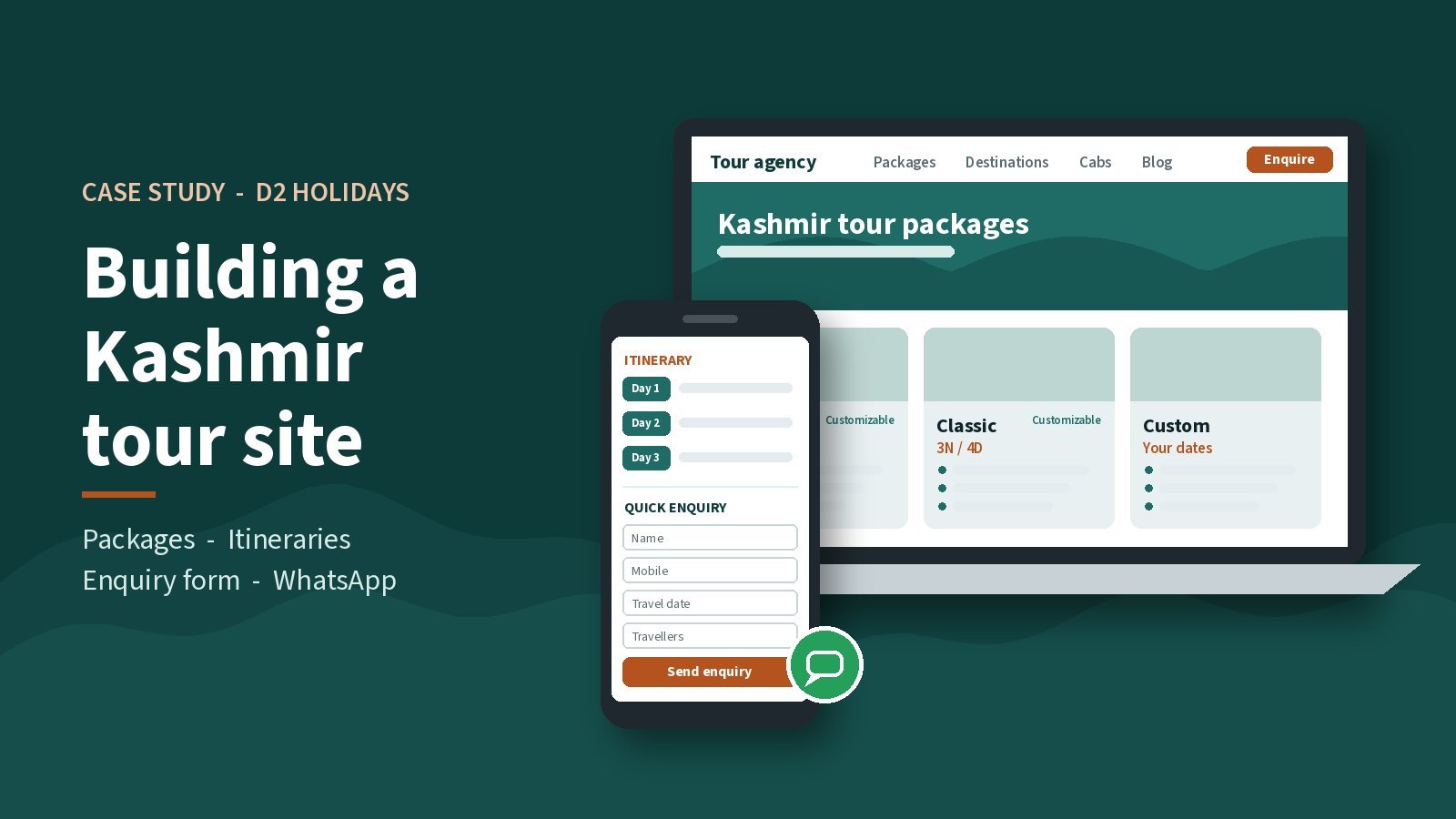
When a family in Pune or Kolkata starts planning Kashmir, they usually open three or four agency sites on a phone, side by side, and close the ones that make them work too hard. A Srinagar agency's website has a few minutes to show a believable plan, the shape of the price, and a real person to talk to. The travel agency website features that matter are the ones that help with those three jobs.
This post walks through d2holidays.com, a Kashmir tour packages site we built for D2 Holidays, a travel agency on Boulevard Road in Srinagar. It covers the website build only: what is on the pages, why it is there, and what we would tell any agency owner who is planning a new site. If you want the service side first, our website development in Kashmir page explains how we scope and price a project.
Who the site is really for
D2 sells family holidays, budget circuits, honeymoon trips and private cabs. The people who land on the site are rarely in a hurry to pay. They are comparing. Most of them want to know four things before they send a message: where they will sleep, how many hours they will spend in the car, what is and is not included, and whether the agency is actually in Srinagar or reselling someone else's trip.
So the test for each page was simple: every page should answer the question that brought the visitor there, and every page should make it easy to ask the next question to a person. Most of what follows comes from that test.
Travel agency website features on the D2 site
Package pages that read like a plan
A package page on D2 is not a price card with a gallery. Take the Kashmir family package. It opens with an overview, then answers the questions a parent actually has: why the family stays in one Srinagar hotel instead of moving every night, what changes when children come along, and how the plan differs from a budget circuit. After that comes a day-wise itinerary, an included list, an excluded list, a short set of questions and answers, and links to related trips.
The excluded list matters as much as the included one. A traveller who sees what is left out up front is less likely to feel cheated on day three, and the agency gets fewer "but I thought" calls.
Itineraries a traveller can adjust
Kashmir trips rarely run as printed. Flights land late, a road closes, a child gets tired of the car. The package cards on D2 carry a clear "customizable" label, and the menu has a standing prompt for a custom trip: tell the Srinagar team your dates and they quote hotels, cab and sightseeing. The family itinerary even says that one day is decided the night before, not on a fixed script.
That is a copy decision as much as a design one. It tells the visitor the agency will talk to them, which is the reason to book locally in the first place.
Destination and activity pages that lead back to packages
Srinagar, Gulmarg, Pahalgam and Sonamarg each have their own page, and so do activities like the shikara ride, skiing, rafting and paragliding. The Gulmarg page covers getting there, the gondola, winter versus summer, and whether to stay overnight or go as a day trip. At the bottom it lists the packages that include Gulmarg.
These pages catch people who are still at the "is Gulmarg worth it with kids?" stage, which is much earlier than "book a package". Linking each one back to real packages is what turns that reading into an enquiry.
Cab and transfer pages for travellers who already have a plan
Not every visitor wants a package. Some have booked their own hotel and only need a car. D2 has separate pages for routes and vehicles: airport transfers, Jammu to Srinagar, Srinagar to Gulmarg, Pahalgam and Sonamarg, Innova Crysta hire and tempo travellers. The Srinagar to Gulmarg taxi page, for example, answers how long the drive takes, which vehicle suits which group, what moves the fare, and how booking works.
For an agency, these pages can bring in smaller jobs that turn into bigger ones once the traveller has spoken to the desk.
One enquiry form, available on every page
Every page ends with the same quick enquiry form: name, mobile, email, city, number of travellers, travel date and a message, with a simple sum to keep spam out. The contact page asks visitors to mention children and whether they want a full package or only a cab, and says the reply is a written quote.
Keeping the form identical everywhere sounds boring. It means the desk always receives the same fields, so the person replying does not have to chase dates or group size before writing a quote.
WhatsApp and a phone number one tap away
In Kashmir travel, a lot of business still happens on WhatsApp. The D2 site has a WhatsApp button and a call link on every page, and the office number sits in the top bar. The site does not force visitors through the form if they would rather message. The aim is to start the conversation, not to win an argument about channels.
Reviews and trip videos where people decide
The home page shows recent Google reviews with links to read all of them or leave one after a trip, and a separate review videos page shows Dal Lake, the Gulmarg meadows and the Pahalgam valleys from past trips. Proof sits next to the packages, not hidden on an about page.
A blog the agency keeps publishing
The site has a blog for practical trip guides, and the latest posts appear on the home page. Seasonal posts answer questions that package pages cannot, such as packing for winter with children or planning a day trip from Srinagar, and each one can point to a relevant package or cab page.
What each feature does for the traveller and the desk
| Feature | What the traveller gets | What the agency desk gets |
|---|---|---|
| Day-wise itinerary with included and excluded lists | A plan they can check against other quotes | Fewer disputes about what was promised |
| Customizable label and custom trip prompt | Permission to ask for changes | Enquiries that already mention dates and needs |
| Destination and activity pages | Answers at the research stage | Visitors who arrive before they have picked an agency |
| Cab and transfer route pages | A clear way to book only a car | Smaller jobs that can grow into packages |
| Same enquiry form on every page | One short form, wherever they are | The same fields every time, so quotes go out faster |
| WhatsApp and call links | Their preferred way to talk | Conversations that start without friction |
| Google reviews and trip videos | Proof from other travellers | Trust built before the first call |
| Blog | Practical guides for their dates | New pages that can be found in search over time |
The parts visitors never see
Some of the work on a travel site is invisible to a traveller but matters to search engines. Each D2 page has its own title written for what that page covers. Pages carry breadcrumbs, the business address and opening hours in structured data, and question-and-answer sections are marked up so search engines can read them. The agency's J&K Tourism registration is shown on the contact page and included in the site's business details. There is a sitemap that lists the package, destination, activity, service and blog pages.
None of this guarantees a ranking, and we do not sell one. It simply means that when someone searches for a Gulmarg cab or a family trip, the right page is clear and easy for a search engine to understand.
What the website does not do
A website is the shop window. It is not the back office. Once an enquiry lands, the agency still has to build the quote, adjust the itinerary, confirm hotels and track payments. D2's site is the public face of the agency, and it does not run on our travel CRM. The website and the desk software are separate jobs.
If your own desk is buried in WhatsApp chats and Excel sheets, that is what TripQuote CRM is for. Our guide to a travel quotation format for Kashmir trips shows what a clean written quote looks like, whatever tool you use to make it.
A checklist for your own agency site
Whoever builds your site, these are the questions we would ask before signing off on the plan:
- Does every package page show a day-wise plan, inclusions and exclusions, not only a price and photos?
- Can a visitor tell, in one line, that the trip can be changed?
- Do destination pages link to the packages that include that place?
- Is there a way to book only a cab or a transfer?
- Is the enquiry form short, the same everywhere, and does it ask for travel date and group size?
- Are WhatsApp and a phone number visible on every page, especially on a phone screen?
- Are reviews shown close to the packages, with a link to the full list?
- Can the agency add blog posts without calling the developer?
- Are your registration, address and contact details the same on the site as on your Google Business Profile?
You can open our other launched sites on the client work page and judge the pages for yourself.
Questions agencies ask before building a tour site
How much does a travel agency website cost with you?
Our website packages are one-time project fees. Basic starts from Rs 30,000 and includes the site, an enquiry form, blogs and a basic SEO setup. Silver starts from Rs 50,000, Gold from Rs 65,000 and Platinum from Rs 85,000, adding things like Google Business Profile setup, ads setup, a social content batch and WhatsApp lead flows. Domain, hosting and ad spend are billed separately. The full comparison is on the website packages page, and a site that does not fit a package is quoted on its own.
Can you build an online booking engine into the site?
Custom booking engines are not part of the standard packages. If you need one, we scope and quote it separately after we understand how your desk confirms hotels and cars today.
Will the new site rank on Google?
We build every site with a structure search engines can read and a blog you can keep publishing. We do not promise rankings. Ongoing search work is a separate service.
Do you only build sites for Kashmir agencies?
No. We are based in New Delhi with a second office in Srinagar, and we take the same packages from agencies and businesses outside Kashmir. Local knowledge helps most when the trips you sell are in the valley.
If you are planning a new site for your agency, start with our website development page, or get in touch with what you sell and who you want to reach. We will tell you which package fits, or whether it needs its own quote.